Strategies to help students overcome math anxiety

According to the latest PISA report, 46% of Spanish students say that math homework makes them feel “very tense.” 39% say it makes them feel “helpless,” and 76% were worried about getting bad grades in the subject. This phenomenon, known as math anxiety, affects not only students’ academic performance but also their emotional well-being.
In the article PISA tests: how to teach and practice math to improve results, we already discussed how to prepare students for these tests, but now we’ll focus on the more experiential side of math. We’ll look at the causes of math anxiety and its long-term impact, and share practical strategies to help Primary and Secondary students overcome it.
Math anxiety in the classroom
With its abstract nature and the constant need to solve problems, math can be a challenge for many students.
A challenge that tests us but can be solved is exciting. A challenge perceived as impossible, however, leads to frustration.
PISA results show a decline in math performance, and one of the factors preventing students from improving their results and enjoying learning math may be precisely that they experience it as an impossible challenge because of math anxiety.
We know that when a student gets stuck learning math, it can lead to growing difficulties, because it’s a subject where new knowledge builds on what has already been learned.
Because mathematical language builds on itself, it becomes increasingly inaccessible to the student, creating a gap between what is taught and what can be understood.
If a student struggles and can’t overcome those difficulties, feelings of inadequacy and frustration set in that can affect their performance in math.
Addressing these math learning difficulties is essential to keep them from becoming an insurmountable barrier. Before we look at math anxiety in detail, here’s a link to the guide Identifying and preventing difficulties in learning math. We’re also sharing Primary math activities, with guidance for supporting diverse learners and working on difficulties. Every bit of help counts in the classroom!
Emotions and math in the school curriculum
Emotions play a crucial role in math anxiety. That’s how Rocío Garrido, a professor of Math Education at the Autonomous University of Madrid who wrote her thesis comparing PISA results across countries with a focus on the social-emotional dimension, explains it: emotion, attitudes and beliefs are intrinsic factors that contribute to math anxiety. A key element that addresses all three is a growth mindset: the belief that abilities can be developed, which transforms attitudes and redirects emotions toward the goal of improving.
Psychologist Carol Dweck developed this popular growth mindset theory, highlighting the importance of seeing challenges and failures as learning opportunities. In math, this means encouraging a positive attitude toward difficult problems and encouraging students to explore different ways of approaching them.
According to the PISA report, 62% of students in Spain show a growth mindset, which is encouraging. Including growth mindset in the school curriculum can be an effective strategy to address math anxiety at its roots. The Spanish curriculum also includes a social-emotional strand, which aims to promote students’ emotional and social development. This holistic approach recognizes the importance of emotions in the learning process and provides tools to address math anxiety from an emotional and relational perspective.
Strategies to overcome math anxiety
Overcoming math anxiety isn’t simply a matter of asking students how they feel or assessing their attitude; it’s a process that takes time and commitment in the classroom. To get there, here are some practical strategies that will help students:
- In-the-moment support. Providing support is essential for addressing math anxiety. This means avoiding situations that can cause stress, such as asking students to solve problems on the board in front of their classmates. Instead, we can help them correct their mistakes and improve in a more individualized, discreet, and personalized way, which is much more comfortable and effective for students than being put on the spot.
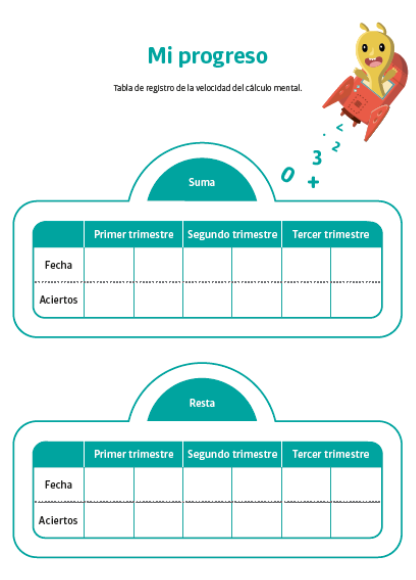
- Tracking and self-assessment. Break the negative perception that “I always do badly” through self-assessment with a portfolio. Students can keep a record of their activities and projects, where you’ll see their achievements and progress. This approach helps change students’ self-image and build a positive narrative around their abilities. One example is this chart from Lemon’s Games, part of our math program EMAT, where students record their progress in mental math.
- Feedback on problems. When working on math problems, it’s important to give specific feedback on the approach, the process and the result. This helps correct mistakes and strengthens conceptual understanding and problem-solving skills. Problem-solving graphic organizers or self-assessment rubrics are also useful.
- Assessing the level of support. Rather than focusing only on giving a grade, it’s a good idea to assess how much support the student needed. This can provide valuable information about the type of support required and guide instructional interventions more effectively.
- Reflection time at the end. At the end of each lesson, you can set aside time for students to reflect on how they felt during class. This practice builds emotional awareness and lets students voice concerns and celebrate successes.
Math anxiety is a significant challenge, but with the right teaching approaches and emotional strategies, we can help students overcome this barrier. Fostering a growth mindset, providing individualized support and using interactive methods will improve students’ experience in math class. It’s not just about improving academic performance, but about building a solid foundation for their development.
As we can see, addressing math anxiety isn’t only up to students; we teachers also play an important role. By applying these strategies and identifying students’ difficulties, we can turn the math classroom into a safe, comfortable space for learning, leaving behind the anxiety, frustration and insecurities that block learning.