PISA tests: how to teach and practice math to improve results
The PISA 2022 report, which focused on assessing mathematics performance, has revealed a significant drop in the level of secondary students. Far from being discouraging, these results can motivate us to reflect on and improve the way we teach math.
To understand the results of the PISA report, you need to know what the tests are like and how they are scored. These tests are designed to capture the level of mathematical literacy of 15-year-old secondary students, which PISA defines as “an individual’s capacity to reason mathematically and to formulate, employ and interpret mathematics to solve problems in a variety of real-world contexts.”
You’ve surely heard a lot about competencies. Spain’s education law, the LOMLOE, places them at the heart of learning, and it is from 8 key competencies that the subject-specific competencies, core knowledge and content are derived. But they aren’t only relevant in Spain! Competencies are central to every international education strategy, always with the goal of preparing students to become capable, resourceful citizens.
A competent student is one who can tackle everyday problems and the challenges of the 21st century. To achieve this, mathematical competency is one of the most essential.
What do students need to know to do well on the PISA tests?
The OECD (Organisation for Economic Co-operation and Development) designs the PISA tests with competency-based questions that can’t be solved just by running through algorithms; students are asked to reflect and apply strategies to solve the mathematical situations presented.
This is one of the key features: contextualized problems assess different mathematical reasoning processes, from lower to higher cognitive complexity. Through problem solving, the tests assess students’ ability to connect mathematical knowledge and put into practice the skills and processes needed to resolve the contextualized situation as effectively as possible.
PISA proficiency levels
Because of the way the competency-based questions are built, the PISA tests can measure students’ level of proficiency. There are 8 proficiency levels, ranging from recognizing information and applying simple algorithms to applying strategies and developing critical thinking in mathematical contexts:
- Level 1c. Answer questions set in easy contexts, with all the necessary information given, following a clear, single-step instruction or operation.
- Level 1b. Answer questions set in simple contexts with all the information in a single representation, recognizing whether there is irrelevant information and carrying out simple calculations with whole numbers.
- Level 1a. Answer questions set in simple contexts, with all the information in familiar formats and from two sources. Easy procedures, minimal synthesis of information and application of basic algorithms, formulas or procedures.
- Level 2. Recognize situations that require designing strategies to solve the problem. Gather information from several sources with somewhat complex representation models. Understanding of functional relationships and simple reasoning.
- Level 3. Design strategies to reach the solution, including sequential decision-making and flexible understanding. Use computational thinking and perform calculations that are not clearly defined. Use spatial visualization or simulation to collect data. Interpretation of sources and reasoning. Percentages, fractions, decimals and proportional relationships.
- Level 4. Work with models for complex problems with two variables, applying more complex computational thinking. Develop critical thinking and integrate different representations of information, linking them to everyday contexts. Argumentation, reasoning and methodology.
- Level 5. Develop and work with models for complex problems and assumptions. Apply problem-solving strategies to more difficult tasks, such as experiments. Reflect on their work and consider the results in context.
How to teach math to develop competent students
The way we assess shapes the way we teach. We can’t expect students to reach the highest levels of mathematical proficiency on the PISA tests if we don’t prepare them for it. To do so, we need to keep in mind spiral sequencing, contextualization, reasoning and consolidation.
Here are some guidelines to make sure your math teaching activities meet these requirements:
- Plan learning according to the principles of math education, from early childhood through secondary: go from simple to complex, connect knowledge and know which concepts are essential to move forward. A spiral sequence is key to deep, lasting learning.
- Design activities with a realistic context in which math can be applied. We don’t mean a word problem with data that’s solved with an algorithm, but a complex situation connected to other disciplines that requires mathematical skills and language to solve it.
- Use mathematical proofs to teach students to reason and prove, make connections, and communicate and represent mathematical knowledge. These processes are essential to becoming competent in math! To design proofs, we recommend the guide Mathematical proofs: an effective explicit teaching strategy in secondary.
- Spend time on consolidating basic math procedures, which are essential for competency. The greater the mastery of basic procedures, the better equipped students are to tackle complex problems with confidence.
To stay consistent, these features must be reflected in both learning activities and assessment activities.
How we prepare for PISA with EMAT and ONMAT: assessment and sequenced activities
For students to reach the highest level of mathematics performance, the OECD highlights the importance of cumulative learning: it’s essential to build a strong foundation of early knowledge, since future learning is built on it. Without a solid foundation, everything collapses!
Let’s look at two contextualized activities, a PISA question and an activity from ONMAT, our secondary math program, to understand how to teach for good results. To start, keep in mind that the PISA report looks at mathematical literacy through the following interrelated aspects:
- Content knowledge. The domain is organized into categories: quantity; uncertainty and data; change and relationships; and space and shape.
- Cognitive process. Mathematical reasoning and the problem-solving cycle: formulate; employ; and interpret and evaluate.
- Context. Real-life situations in which the questions are set, along with selected 21st-century skills that underpin and are developed through mathematical literacy: personal, occupational, societal and scientific.
Therefore, students’ acquisition of mathematical literacy is observed through a systematic sequence of activities that brings together knowledge (core knowledge) and processes (subject-specific competencies). These activities must also take place in a real-life context or be based on fictional but plausible situations in which math can be applied to solve problems.
Example of a PISA 2022 math question
Now that we know the theory, let’s put it into practice. Let’s analyze the aspects of this triangle pattern question from the PISA 2022 math test:
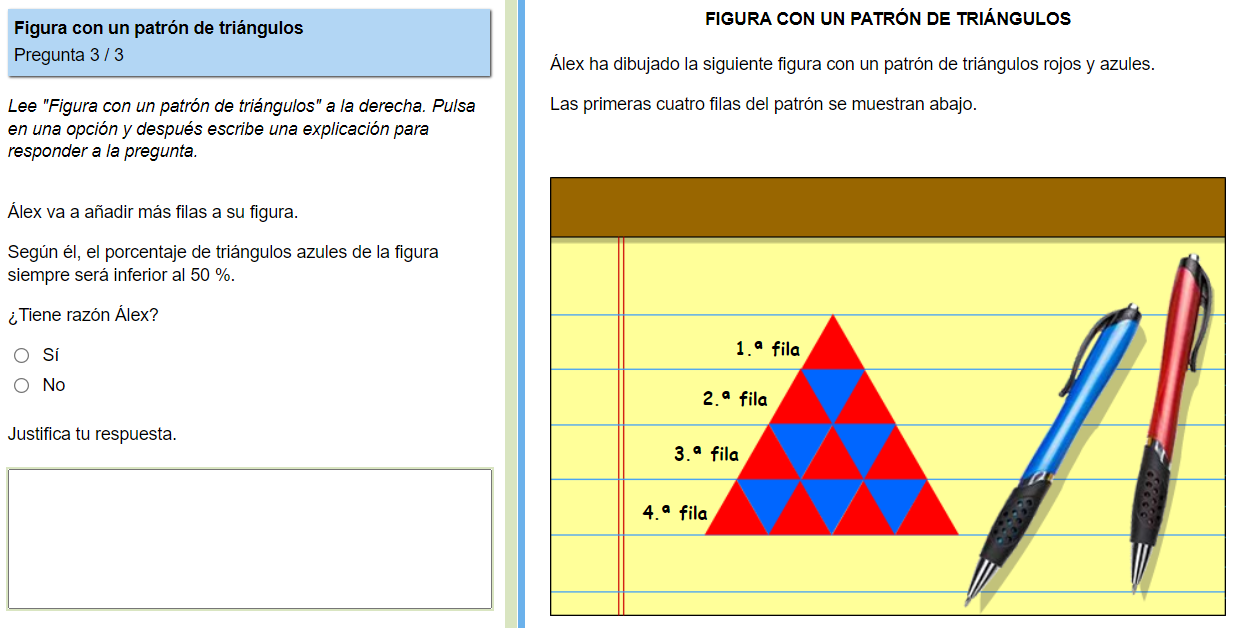
- Content area: change and relationships, algebraic sense, patterns.
- Cognitive process: reasoning; students must formulate and test simple conjectures by analyzing the pattern (specific math competency 3) to recognize the relationship between the number of red and blue triangles in each row, and use this relationship to justify their answer.
- Context: scientific, since all the elements belong to the field of mathematics.
Example of an activity in EMAT and ONMAT
All EMAT and ONMAT activities include detailed pedagogical information on the same aspects we find in PISA questions.
This 9th grade activity is equivalent to the PISA triangle pattern question, since it works on the same aspects:
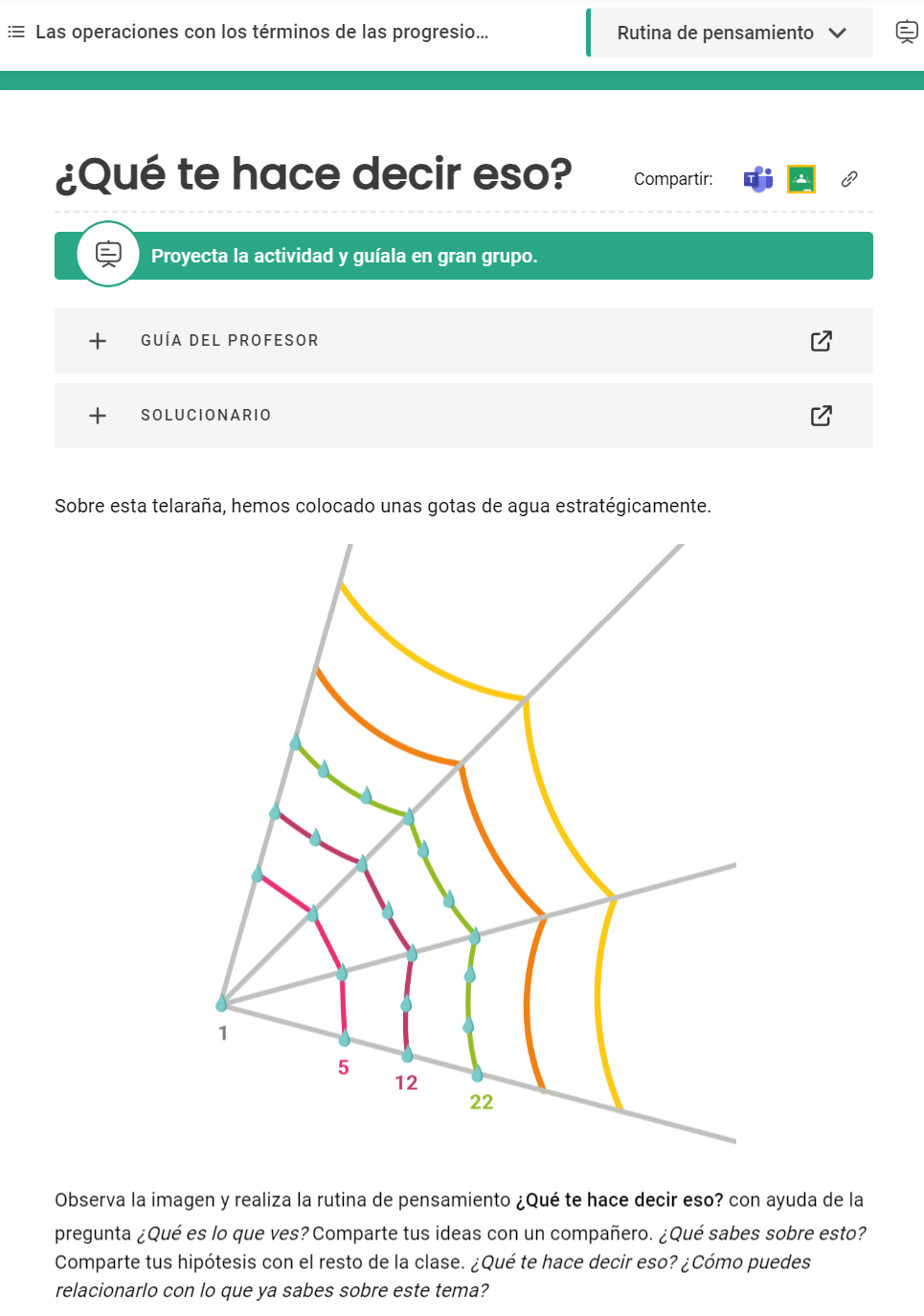
- Content area (core knowledge): change and relationships, algebraic sense, patterns.
- Cognitive process (competencies and criteria): a reasoning routine in which students formulate and test simple conjectures, with guidance, by analyzing the pattern of water droplets on a spider web (specific math competency 3).
- Context: scientific, applied to the natural world.
Competency-based assessment: practice the PISA tests in EMAT and ONMAT
The programs offer sequenced resources, activities, exercises and assessment tools that enable competency-based learning and countless opportunities for the teacher to observe and assess it.
Competency-based teaching is only complete if assessment is competency-based too. Throughout the 4 years of secondary (7th–10th grade), different assessment and self-assessment tools are built in to evaluate students’ level of mathematical competency.
In EMAT and ONMAT, students can prepare directly for PISA with auto-graded tests in the same format as the official ones, since the platform includes activities and tests from previous editions. Give them a try in your classroom!
Want to learn more about applying competency-based teaching in your math classes? Contact us and our team of educational consultants will show you the strategies and tools in the EMAT and ONMAT programs.
Discover all the content!