
A learning situation for your math class
Learning situations are one of the hot topics right now. Spain’s LOMLOE education law emphasizes competency-based learning and stresses that it’s important not only for students to acquire knowledge, but also to know how to apply it in their daily lives, and that’s where learning situations come in. To achieve this, teachers are asked to design activities in which students use what they’ve learned to solve everyday problems. After all, it’s about preparing children for real life.
If you’d like to learn more about learning situations, we recommend the article LOMLOE learning situations: what they are and how to design them and the webinar What are learning situations, and what aren’t they? Competency-based activities for your classroom.
Example of a learning situation for Primary
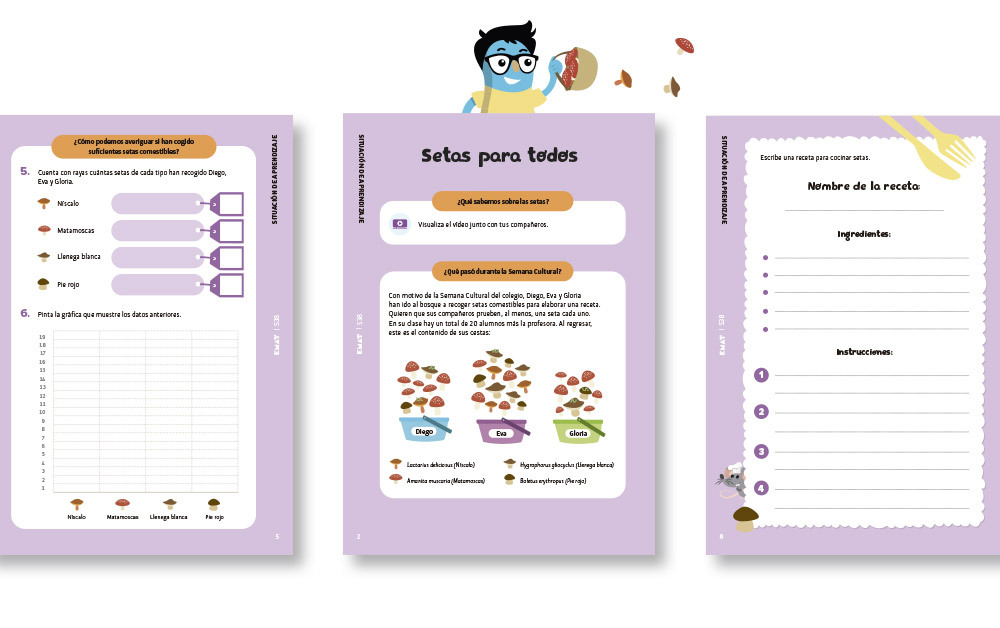
In our math program EMAT, we include three learning situations throughout the school year, one at the end of each term. Today we’re focusing on one of them, Mushrooms for everyone, which is part of the 1st grade teaching plan.
The learning situation is made up of the following phases:
- Activation: What do we know about mushrooms? We activate students’ knowledge about mushrooms with an explainer video that works both for those with some prior knowledge and for those without. By the end, they’ll know what mushrooms are, how they differ from other fungi, and whether or not they’re edible.
- Context: A contextualized problem is presented. In this case, three students go mushroom picking in the forest with their teacher, and they want each of their classmates (20 in total) to be able to try at least one.
- Exploration: Let’s think about what the problem is, what information we have, and what we need to know to solve it.
- Organization: Once the information has been gathered, students are encouraged to organize it so they can solve the problem. For example, they need to take into account that some of the mushrooms they picked in the forest aren’t edible.
- Activation: How can we find out whether they picked enough edible mushrooms?
- Application and checking: How do we decide to solve the problem? In this case, the problem is that, after doing the calculations correctly, there aren’t enough edible mushrooms for all the students. Students are free to come up with open-ended solutions: one could be going back to the forest to pick more edible mushrooms so everyone can try one.
- Final product: we suggest creating a recipe for cooking mushrooms.
- Reflection: the final phase for thinking about what was learned, how it was learned, and the different ways to solve the same situation.
This is just a short summary of the EMAT learning situation. Want to download the full version? At the link below, you’ll find all the content for both the teacher and the student. Get it for free and use it in your classroom!
