
Making sure every student keeps up with the lesson plan without leaving anyone behind is one of the biggest challenges in the elementary classroom. Often, a packed curriculum pushes us from one session to the next without that vital time to consolidate what has been learned. This lack of review time makes students feel insecure and puts constant pressure on teachers, who feel they “can’t keep up” with assessing each child’s progress.
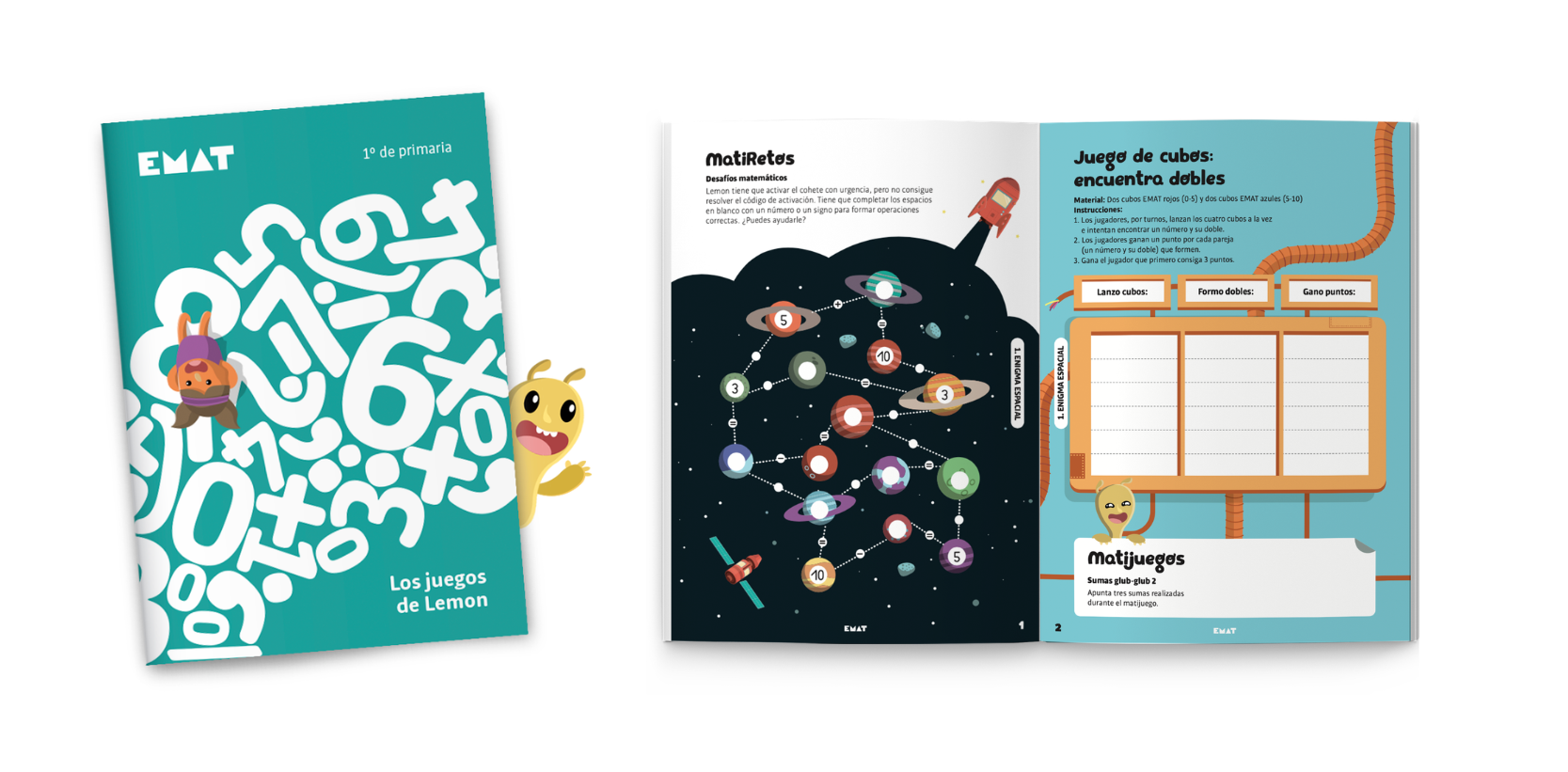
EMAT meets this need with Los juegos de Lemon (Lemon’s games), a resource designed to turn systematic practice into a fun and flexible experience.
Would you rather watch a video?
Before we dive into the methodology, we invite you to watch this short documentary (in Spanish). In it, teachers explain how Los juegos de Lemon let them “stop the clock,” support diverse learners, and enjoy more relaxed and effective math.

What are Los juegos de Lemon?
Los juegos de Lemon are an activity book and a dedicated practice session within the EMAT Primary program, designed to reinforce, consolidate, and review the knowledge covered in previous sessions through a fun and motivating approach.
These sessions combine math challenges, calculation games, and problem solving that students can do in cooperative teams or individually, fostering autonomy, collaboration, and motivation.

Why they matter in the elementary classroom
Review has traditionally been seen as a reproductive and sometimes monotonous task. However, the tekman Education methodology recognizes that consolidating concepts requires practice that is not only reproductive but also productive.
The value of this resource rests on three key pillars:
- Time management: it frees teachers from having to improvise review sessions by building them systematically into the lesson plan.
- Less anxiety: presenting math in a more relaxed way removes the pressure of making mistakes, so students gain confidence.
- Faithful to the curriculum: it isn’t “extra” or wasted time; it’s a planned session that covers curriculum content in depth.
Students can also record their results and reflect on their own learning, encouraging self-assessment and peer assessment, which also helps teachers monitor individual progress.
How it works: from theory to practice
The success of Los juegos de Lemon lies in its structure. It isn’t just a set of exercises, but a session with an engaging storyline for EMAT students.
- Systematic frequency: there is one Los juegos de Lemon session for every four sessions of new content. This ensures that no concept is forgotten.
- Opening challenge: sessions usually start with a whole-class challenge that activates logical and abstract thinking and motivates the group.
- Simultaneous activities: the class can be organized into small teams that work independently on different activities.
This format meets the goals of the learning situations set out in Spain’s education law (LOMLOE), promoting competency-based learning and student autonomy.
Supporting diverse learners and the teacher’s role
One of the biggest advantages of Los juegos de Lemon is the flexibility it gives teachers. With students working in stations or small groups, the teacher can:
- Observe and assess: it’s the ideal time for formative assessment, identifying who has understood a concept and who needs support.
- Targeted intervention: the teacher can sit with a specific group that is struggling with a particular skill while the rest work independently.
- Adapting levels: since it’s a flexible resource, it’s easy to adapt the activities or teams to each child’s learning pace.

FAQs: frequently asked questions
1. Do Los juegos de Lemon replace the traditional textbook?
No, they are an essential complement within EMAT that serves as a practice and reinforcement book, fitting seamlessly into the program’s teaching sequence.
2. How do they help students who struggle with math?
In a playful environment, students dare to try, make mistakes, and correct each other.
3. Do all the activities have to be done in a single session?
Sessions are flexible. Teachers can choose the structure that best suits their group, whether starting all together or rotating through different challenges.
4. How long does a typical session last?
Between 30 and 50 minutes, depending on the number of stations and the time available. Each activity can last about 10 minutes.