
How can you spark mathematical thinking in your secondary classroom?
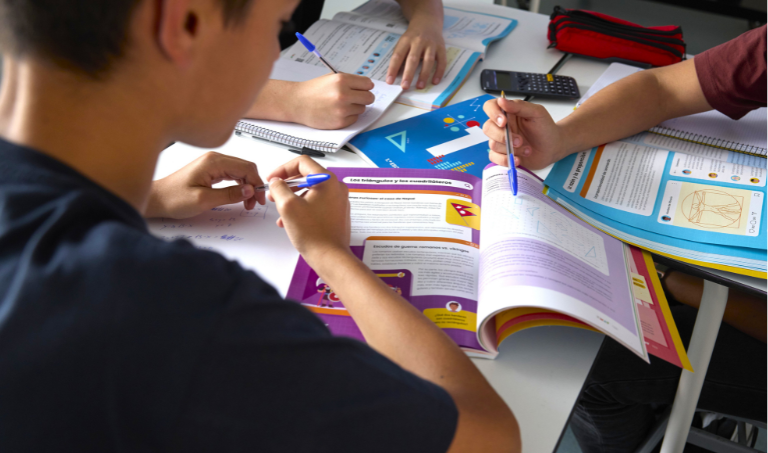
Have you ever noticed a student’s face when they suddenly understand how a complex mechanism works thanks to a piece of math? That’s the moment when mathematical thinking wakes up. In secondary school, our goal is to make that process visible: for students to become aware of how they reason, deduce, and create.
By embracing real-world math, you turn your classroom into a true thinking lab.
Math for the real world
Assessing math competency is a constant in international tests such as PISA. Traditionally, being competent in math meant mastering basic arithmetic skills: working with fractions, solving for an unknown, or calculating the area of a polygon. Today, the LOMLOE (Spain’s education law) and the global context require us to go a step further: to educate thoughtful citizens who are engaged with their times.
A student who is competent in math should be able to use deductive and inductive reasoning to tackle the complex, defining problems of our century, such as climate change, the global economy, or health crises. The goal is no longer just for them to know how to calculate, but to understand what they should calculate and why.
Teaching to think: understanding to remember better
Think before you solve. This is one of the things we ask of our students most often, but are we really teaching them how to think?
In secondary school, too much memorization of meaningless abstract algorithms leads to disengagement, frustration, and math anxiety. To avoid this, we need to base learning on deep understanding.
When students understand the geometric or arithmetic logic behind a concept (because they’ve touched it, visualized it, and deduced it), their working memory is freed up. They don’t need to memorize a formula blindly because they can reconstruct it logically.
Understanding is the best way to remember
4 tools for deep learning
To transform your classroom and apply true Universal Design for Learning (UDL), adding an isolated game-based activity on Fridays isn’t enough. You need an ecosystem of resources that diversifies the ways all your students can access knowledge. In EMAT Secondary, we do this through:
- Questions that spark curiosity: instead of simply presenting the theory, we ask questions that invite inquiry and offer real cases connected to students’ interests (sports, social media, science…).
- Making the learning process visible: we use routines (such as See, Think, Wonder or Compare-Contrast) and graphic organizers (mind maps) that let students show clearly and independently how they reason. This helps them structure their ideas and understand the process they followed to reach the solution.
- Hands-on math: moving from the concrete to the abstract is vital. Activities in which students manipulate objects allow them to deduce complex concepts empirically before formalizing them algebraically.
- Assessing for life: we work with authentic tasks. These are competency-based activities, inspired by PISA tests, in which students must interpret tables, discard irrelevant data, and make decisions based on mathematical evidence.
Here’s a free practical guide on mathematical thinking: How to teach your secondary students to think in math class. It also includes a free EMAT Secondary activity you can try in class today.

A real example for sparking mathematical thinking
How can you bring all this into an activity book without tripling your workload as a teacher?
We’ll show you with this real example from the 9th grade unit “Operations with the terms of sequences”:
How does a virus spread? – PISA practice

Instead of asking students to simply apply the formula for the general term, EMAT Secondary presents them with a real scenario: how scientists use mathematical models to predict the spread of a pandemic. It’s structured using the low floor, high ceiling strategy:
- The context (low floor): accessible to everyone. It explains that each infected person infects others, and students are asked to compare a very simple model of direct transmission (adding a fixed number each week, an arithmetic sequence) with how infection really spreads.
- Understanding and analysis (middle): students must calculate how many people will be infected in the fourth week if each person infects 3 new people (exponential spread, a geometric sequence).
- Critical thinking (high ceiling): the problem doesn’t end with the calculation; it introduces a social variable (vaccines). Students are challenged to recalculate the data assuming the transmission rate drops to r = 1.2 and to reflect on how the sum of infinitely many terms of a sequence helps us understand whether a virus will eventually disappear.
With activities like this, students don’t just learn to use a formula; they understand how math can save lives.
EMAT Secondary: your ally for math class
Embracing innovative, competency-based methods that spark your students’ mathematical thinking shouldn’t mean an impossible extra effort in your daily planning. EMAT Secondary is the program that will become your ally in the classroom.

How does a competency-based approach help improve results on PISA tests?
The competency-based approach of programs like EMAT trains students to solve problems in real contexts, which is exactly what PISA assesses. By working on data interpretation and critical reasoning instead of mechanical repetition, students gain confidence and agility in unfamiliar situations.
How can we make mathematical thinking visible in the secondary classroom?
At tekman Education, we use thinking routines and graphic organizers. When a secondary student draws a mind map or uses a routine like “Compare and Contrast” with an arithmetic and a geometric sequence, they are externalizing their thought process. This lets the teacher spot underlying misconceptions and helps students become aware of how they learn (metacognition).
How do mistakes influence the development of mathematical reasoning?
Mistakes are a key part of mathematical thinking. Instead of penalizing them, in EMAT we use them to drive learning. Analyzing why an AI gets a proportionality calculation wrong, or why an infection model doesn’t match reality, pushes students to engage their critical thinking and re-evaluate their own deductions.