
How to teach reflection on language in secondary school: from mechanics to critical thinking
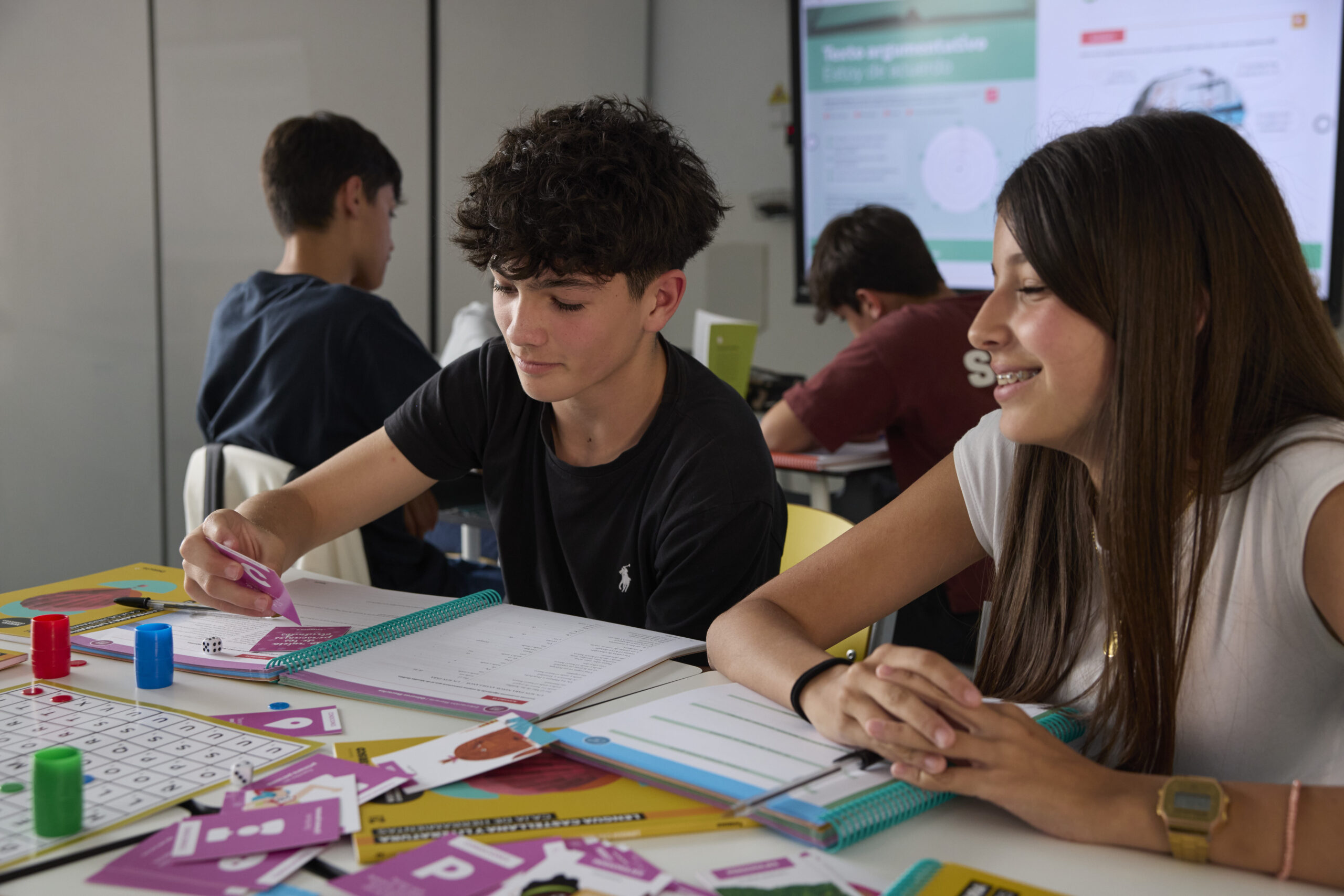
Traditionally, grammar teaching has been based on a model of mechanical transmission in which students acted as passive recipients of abstract rules. The main goal was the syntactic labeling of isolated sentences with no context. However, the curriculum and educational neuroscience call for a shift toward understanding the system, transforming the way students interact with their own language.
What is reflection on language?
Reflection on language is students’ ability to observe, manipulate, and understand the language system consciously, going beyond simply identifying grammatical labels to understand how language builds meaning in real contexts.
Many secondary language arts teachers find that their students memorize types of determiners or analyze sentences automatically, but can’t apply that knowledge to improve their own writing or reading comprehension. This disconnect causes frustration in the classroom and the feeling that grammar is a set of isolated rules with no practical use.
Grammar should become an applied tool for reasoning about how language works, allowing your students to improve their writing and develop logical thinking by solving syntactic and morphological problems.
How can this learning be sequenced throughout secondary school?
For reflection on language to be effective, it shouldn’t be approached as a cyclical repetition of isolated concepts, but as knowledge that is built and deepened throughout secondary school. The key is a sequence that follows students’ cognitive development, allowing them to progress from a functional foundation to full autonomy in analyzing complex structures.

- 7th grade – Foundations and sentence modality: The structural foundations are laid in a functional way. The focus is on the subject-predicate relationship (including elliptical and impersonal subjects) and on classifying sentences according to the speaker’s attitude (imperative, optative, etc.).
- 8th grade – Phrase structure and the simple sentence: Students learn to break down the simple sentence in full. They work on formally identifying the five types of phrases (noun, verb, adjective, adverb, and prepositional phrases) and basic complements such as the direct object, indirect object, subject complement, and adverbial.
- 9th grade – Advanced complements and coordination: This year acts as a strategic bridge to the compound sentence. More abstract complements are introduced (prepositional object, predicative complement, agent complement, and locative complement), along with a detailed study of the uses of the Spanish pronoun “se.” Students also begin working in depth on coordination and juxtaposition.
- 10th grade – Subordination and complex analysis: The final year focuses on the formal and semantic complexity of subordinate clauses (noun, relative, and adverbial clauses). To round off secondary school, students are given systematization tools, such as dichotomous keys, so they can carry out independent, step-by-step analyses.
Practical classroom strategies
To put grammatical reflection into practice, we can use a variety of strategies.
- Cross-curricular, progressive integration: Syntax isn’t treated as an isolated unit, but as a thread that is built throughout all grades.
- Discovery learning (minimal pairs): Linguistic reflection is encouraged through contrast tests. Instead of memorizing rules, students analyze how small grammatical changes (such as the position of a comma or a change of word) completely transform the meaning of a sentence, following the model of Spain’s university entrance exams (PAU).
- Logical, hierarchical analysis: To demystify sentence complexity, visual tools such as dichotomous keys and step-by-step protocols are used. This lets students see the hierarchy of syntactic units and progress confidently from simple structures to compound sentences.
- Hands-on manipulation and active construction: Grammar is explored hands-on through substitution and commutation. Activities include transformation tasks and tools such as the sentence-building wheel, where students create their own sentences by applying specific grammatical categories and functions.
The Asterisco approach
In the Asterisco program, grammar stops being a memorization exercise and becomes living learning. Asterisco includes specific tools so students can reason about the language system:
- Visual scaffolding and analysis protocols: dichotomous keys and structured steps that help students tackle syntactic hierarchy with confidence and rigor.
- Thinking routines and strategies: activities designed to connect prior knowledge and apply it in real communicative situations.
- Focus on syntactic awareness: syntax is integrated as a crucial cross-curricular thread for improving reading comprehension and writing.
- Contrast methodology: systematic use of minimal pairs and transformation exercises (such as turning subordinate clauses into equivalent phrases) to confirm syntactic functions through logic.
Asterisco offers an ecosystem of resources that turn the language arts classroom into a laboratory for linguistic reflection.
Download activities for your language arts classes
We’ve prepared two guides with more information and activities from the Asterisco program (one on syntax and one on morphology) so you can work on reflection on language with your secondary students (in Spanish).


If you teach Catalan, you’ll find your guides here.
Frequently asked questions
How does the LOMLOE (Spain’s education law) affect the teaching of syntax?
The LOMLOE shifts the focus from mechanical labeling to the competency of reflecting on language, prioritizing understanding of the language system and its use in real contexts.
Why is it important to teach syntax across the curriculum?
Teaching it in an integrated way directly improves students’ ability to structure their own texts and unpack the meaning of complex readings, while developing logical thinking.
How can morphology be taught without memorizing lists?
The approach is applied morphology. Instead of defining categories in isolation, students manipulate the structure of words (root and inflections) to understand how they change category and what nuances they bring to real discourse.
What are minimal pairs and how are they used?
It’s a linguistic reflection technique that uses contrast tests between two almost identical sentences. For example, students analyze how a comma changes the meaning of an adjective from restrictive to non-restrictive, following the models of Spain’s university entrance exams (PAU).