Strategies for supporting diverse learners in your secondary math classroom

The reality for any secondary math teacher is challenging, to say the least. You walk into the classroom and find different learning paces: some students solve quadratic equations quickly, while others are still struggling with fractions or basic elementary operations.
Supporting diverse learners in math isn’t just a requirement of Spain’s education law (LOMLOE); it’s one of teachers’ main concerns. How do you explain a new concept without boring those who are ahead or frustrating those who are stuck?
The challenge of inclusive math in secondary school
Moving up to 7th grade, the first year of secondary school, is a major school transition. This change is often harder because many students are still developing key cross-curricular skills: they arrive lacking organizational autonomy, struggling to understand word problems, or with a low tolerance for frustration. This general context has a direct impact once we get down to math.
In math specifically, we find a wide range of levels: students ready to make the leap to abstraction share the classroom with others who haven’t consolidated basic elementary knowledge. Every day we meet students who hesitate with their multiplication tables, struggle with decimals, or haven’t internalized the concept of a fraction, which makes it harder to introduce new units such as integers.
As the international TALIS survey points out, managing these different paces with dense curricula and limited resources is one of the most stressful challenges for teachers. Today’s challenge is to achieve inclusive teaching in which all students make meaningful progress, without teachers burning out in the process.
The UDL framework: designing for everyone from the start
To manage this reality, Universal Design for Learning (UDL) has become the essential reference framework. Unlike traditional accommodations, UDL proposes designing a math class that is accessible to everyone from the outset, based on three pillars:
- Multiple means of engagement: to spark interest, sustain effort and persistence, and provide options for students’ self-regulation.
- Multiple means of representation: to help students connect ideas with different ways of representing them. This way, learning doesn’t stay isolated but becomes useful and easy to apply in any real-life situation.
- Multiple means of action and expression: to allow each student to learn, show what they have learned, and use their executive functions, regardless of their personal characteristics or preferences, or of barriers arising from their development.
UDL gives us the framework for designing an inclusive math class, but how do we bring it into the classroom? To go from theory to practice, we need concrete tools that turn these pillars into a practical, manageable methodology for teachers.
Three practical classroom strategies
1. Multilevel teaching: low-floor, high-ceiling activities
Multilevel teaching aims to offer a single challenge that can be approached at different levels of complexity. This lets the whole class work on the same concept while respecting individual paces.
In your math activities, you can set challenges with a simple, visual entry point (accessibility) that also allow complex or abstract exploration for those who need it (depth). The activity itself should be designed to allow multiple ways of accessing the content and expressing learning, following UDL principles.
For example, you can start a unit on powers with a thinking routine such as See, Think, Wonder using an image of bacterial growth. Any student can take part through intuitive reasoning (low floor) or through mathematical reasoning, proposing a numerical representation of the bacterial growth (high ceiling).
2. Visual and hands-on scaffolding
Many secondary students freeze when faced with pure abstraction. That’s why it’s vital to make sure students understand the mathematical concept. An excellent way to ensure understanding is to use concrete language—in this case, hands-on and visual.
So it’s vital to support the explanation of and reflection on new math concepts with physical or visual aids that represent the concept before tackling the calculation. If we start from understanding, when it’s time to solve a math problem, students will be able to analyze the context and make decisions using the most suitable strategy.
Good strategies include hands-on activities guided step by step, or even very visual, schematic reference material that students can consult on their own, with the procedure numbered and linked to a visual example.
3. Formative assessment: mistakes as a diagnostic tool
Math anxiety is real and usually stems from a fear of failing in public. If we change how mistakes are perceived, we transform the emotional safety of the classroom. The goal is for students to be aware of their own learning process.
To achieve this, the first step is to replace punitive assessment with self-assessment and reflection tools that help students become aware of their learning and self-regulate. It’s also very important to know when, how, and about what to give students feedback, especially when we go over exercises or tests with them.
There are countless self-assessment strategies that have proven immediately effective. From tools like the metacognition ladder, which helps students reflect on their own learning and on why math matters, to more cross-curricular methods like cooperative games, which provide instant feedback and let mistakes be handled as a group and in a playful way.
EMAT Secondary: your ally for truly supporting diverse learners
At tekman, we know that theory sounds great, but teachers’ time is limited. That’s why we designed EMAT Secondary, a program that follows UDL principles and is built to make inclusive math a manageable reality in your day-to-day teaching.
How does EMAT help all your students reach their full potential?
- Multilevel interactive exercises: Students show their competence through digital challenges with different levels of complexity, adapting to the different paces in the classroom.
- Practica + workbook: Dedicated resources for multilevel sessions, making it possible to reinforce foundations or extend learning for more advanced students without creating separate tracks.
- Transition materials: Review units from 5th and 6th grade to consolidate the foundations. By ensuring a solid starting point, we prevent frustration and help students feel capable of persevering in their learning.
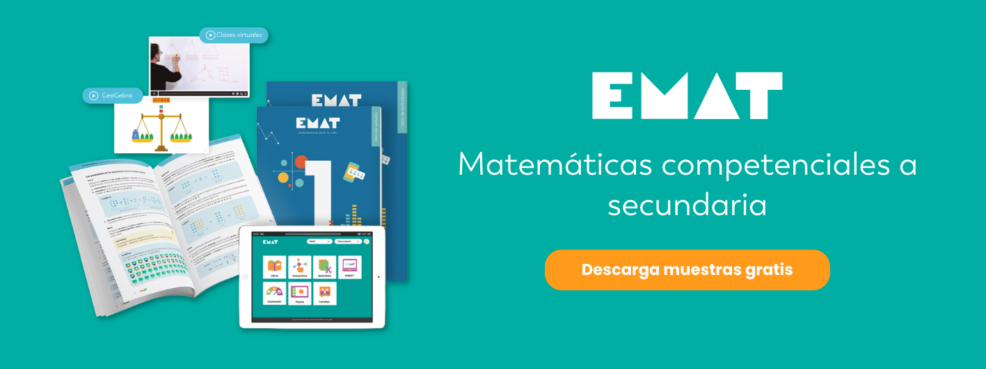
- Visual, inclusive reference book: Math content with visual support, step-by-step procedures, and strategies for organizing knowledge. It’s excellent scaffolding that keeps information accessible to everyone at all times.
- Ongoing formative assessment: Self-regulation tools that respect individual paces and turn mistakes into opportunities for improvement, sustaining motivation and effort.
- Engaging, real-world activities: We present information in different formats (diagrams, videos, lessons), guiding students as they reason through concepts and algorithms. Diversifying the ways information is presented ensures that reasoning and understanding of algorithms don’t depend on a single format.
Understanding that every student is unique is the first step toward meaningful math teaching. When you have the support and materials you need, it’s much easier to guide each student through their own growth process.