
“For me, writing is rewriting”: Roque Larraquy and literature as a dissection of language
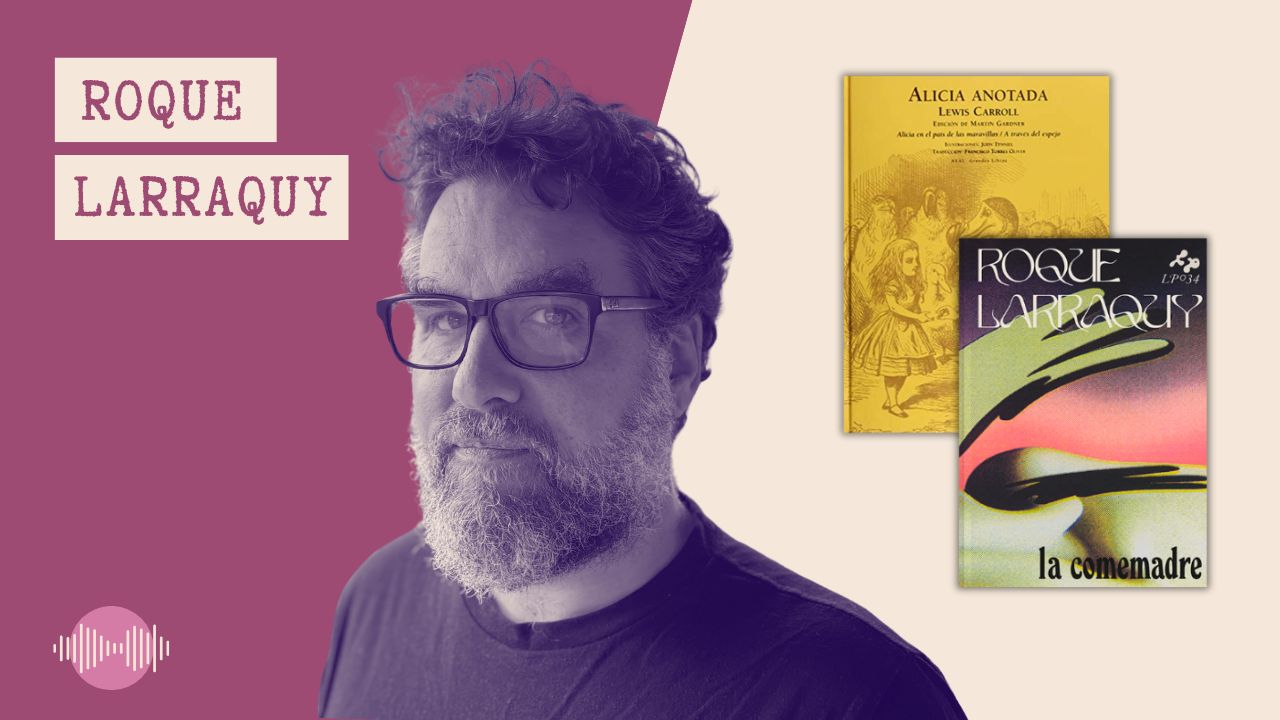
In this episode of Secretos a Voces (in Spanish), Lea Del Pozo talks with Roque Larraquy, an author whose writing stands out for its originality and precision. Starting from his novel La comemadre (published in English as Comemadre) and his interest in Alice’s Adventures in Wonderland, the conversation leads us to reflect on the limits of language, rewriting, and the role of humor in literature.
La comemadre: meticulous literature and narrative experimentation
La comemadre is a novel in two parts, with some of the most flawless and economical prose in Latin American fiction today. Nothing escapes Larraquy and he makes no concessions: every word is meticulously weighed and there isn’t a single unnecessary sentence. His prose is relentless and razor-sharp.
The first part takes us to a sanatorium on the outskirts of Buenos Aires in 1907. A group of doctors carries out macabre experiments to try to unravel the mystery of death. Amid this chilling scientific setting, the protagonist discovers something like love.
In the second part, set in 2009, we follow a conceptual artist obsessed with turning his own body into art, defying every moral boundary. Larraquy is drawn to despicable, misogynistic, or fascist characters who serve as mirrors of broader realities, but he also deals with love and death.
Roque Larraquy and Lewis Carroll
During the episode, Roque Larraquy reflects on the influence of Alice’s Adventures in Wonderland, a book he first read at the age of six and has never stopped rereading. Like Lewis Carroll, Larraquy challenges conventional narrative logic and builds worlds where the absurd, humor, and the breakdown of language are key.
If Carroll used mathematical logic and wordplay to create a dreamlike, bewildering universe, Larraquy takes that spirit into contemporary literature, with a rawer and more unsettling aesthetic.
Roque Larraquy on Secretos a voces
The conversation covered a range of topics:
- The difference between creative writing in Latin America and the English-speaking model.
- Humor as a narrative strategy and a tool for critique.
- Rewriting as the essence of literature.
- The absence of a traditional plot as an aesthetic device.
- Fiction as a tool for exploring the grotesque in art.
- The influence of Alice’s Adventures in Wonderland and Lewis Carroll’s other Alice books on his work.
- Roque Larraquy’s open secret.
About Roque Larraquy
Roque Larraquy is a writer, screenwriter, and one of the most solid and surprising voices in Latin American fiction. His first novel, La comemadre, was longlisted for the National Book Award for Translated Literature and has been published in more than twenty countries.
His other books include Informe sobre ectoplasma animal (Report on Animal Ectoplasm, 2014), illustrated by Diego Ontivero, and La telepatía nacional (National Telepathy, 2020), chosen by The New York Times as one of the ten best Spanish-language books of that year. In Spain, La comemadre was published in 2022 by Fulgencio Pimentel in a beautiful edition.
About the classic Alice’s Adventures in Wonderland and Lewis Carroll
Published in 1865, Lewis Carroll’s Alice’s Adventures in Wonderland is a classic of world literature that has influenced generations of writers and artists. Its ability to subvert logic and play with language has made it an inexhaustible reference for experimental literature and the exploration of identity.
- Real-life inspiration: Lewis Carroll (whose real name was Charles Dodgson) wrote the story to entertain Alice Liddell, the daughter of a friend. The first version of the story was called Alice’s Adventures Under Ground.
- Mathematical and logic games: besides being a writer, Carroll was a mathematician. Alice’s Adventures in Wonderland is full of logical paradoxes and math problems disguised as wordplay.
- Alice in Wonderland syndrome: there is a neurological disorder by this name that distorts the perception of the size of objects and of one’s own body, similar to what Alice experiences when she shrinks and grows in the story.
Over the years, Alice has been reinterpreted in many ways: from Dalí’s surrealism to psychoanalytic and philosophical readings that see her journey as a questioning of the self and the perception of reality.
Listen to or watch the full episode
Discover all the details of this conversation with Roque Larraquy on Secretos a Voces (in Spanish). Listen on your favorite platform and dive into a fascinating talk about literature, art, and narrative experimentation.
Listen to the episode on Spotify.
Watch the episode on YouTube
Subscribe to the newsletter and follow us to stay up to date on every new episode.
If you love literature and enjoy discovering writers’ motivations and thoughts, Secretos a Voces is for you. A new podcast episode every two weeks! And you’ll find more literature on the Secretos a voces Instagram account.
Don’t miss this related content:
- Secretos a voces, Lea del Pozo’s new literary podcast
- Episode 1: Cristina Andrade on Secretos a voces
- Episode 2: Jesús A. Ponce on Secretos a voces
