
Adriana Salazar: “One of the benefits of chess is that it exposes us to both victory and defeat”
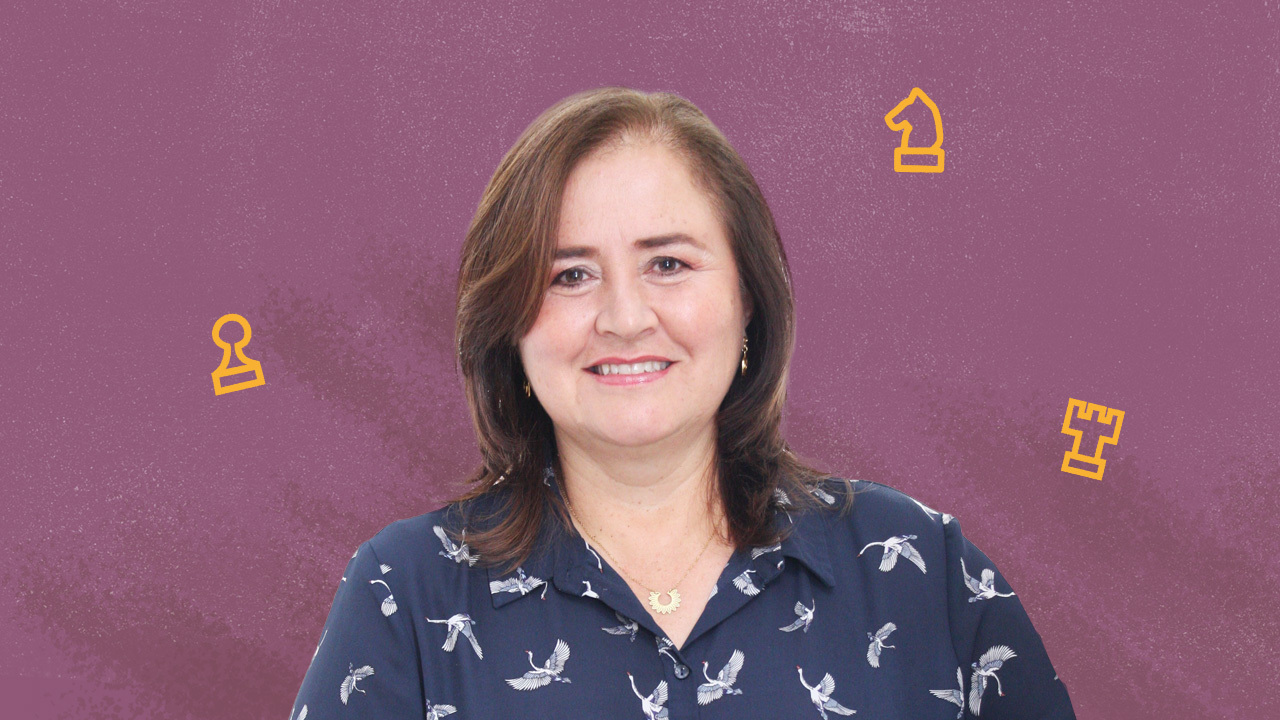
Adriana Salazar has devoted her life to teaching and to chess, and drawing on all her experience and knowledge, she created the Ajedrez en el aula educational program for students ages 3 to 12. Introducing this ancient strategy game awakens students’ minds and brings many benefits that carry over into learning other subjects, such as math. Don’t miss this in-depth interview!
Interview with Adriana Salazar, chess International Master
What inspired you to create the Ajedrez en el aula program, and what was the process like?
It’s been a process of more than 40 years! As a teenager, I started teaching chess while developing my career as a professional chess player. Everything was very intuitive; I imagined how to teach so I could connect with my students and make it fun for them. I created materials, but without technology, and collected successful ideas and activities. I also observed how children thought, what they found difficult, and why they didn’t understand certain things. In my very first class, I talked about “the land of vanilla and chocolate,” and that metaphor has lasted ever since, as have the benefits of learning with the body on a giant board on the floor.
I spent many years in the classroom, working as director of preschools in Bogotá and studying Linguistics and Literature at university, until Mother Montserrat del Pozo and Mother Cecilia Cortacans contacted me to bring chess to the schools of the Missionary Daughters of the Holy Family of Nazareth. We began training teachers, and I wrote Juega el maestro y ganan los niños (The teacher plays and the children win) and the first 6 books. I wrote the Student books and the Teacher’s guides, and developed materials for myroom: presentations, stories, games, and music. The Teacher’s guides evolved with Teaching for Understanding and multiple intelligences, and I had them reviewed by two collaborators from Harvard University. Later, we created online professional learning for teachers and more than 70 explanatory videos for the sessions.
Ajedrez en el aula is a program that was born in schools, built on experience and constantly evolving. It has reached Spain, Colombia, Mexico, the United States, Argentina, Ecuador, Chile, Paraguay, Australia, and the Dominican Republic. Thousands of children have learned with Ajedrez en el aula as part of their school curriculum, and thousands of teachers have learned how to teach chess. I always remember that it had the support of Mother Montserrat del Pozo, Mother Cecilia Cortacans, the Innovative Schools community, and tekman Education; without them, we wouldn’t be talking today about this program that has crossed borders. Thank you all!
What are the benefits of bringing chess into the classroom?
As teachers, we work hard in the classroom to increase our students’ attention, improve their concentration, and develop skills such as memorizing, observing, classifying, encoding, decoding, calculating, visualizing, problem solving, analyzing, and synthesizing, among others, and to develop different kinds of thinking, especially critical thinking. Chess, an ancient game, offers all these possibilities and works like a mental gym. Then there are social skills and values. Chess is the perfect setting for teaching respect, responsibility, independence, self-esteem, patience, and tolerance, and for learning to accept both victory and defeat. Integrating chess into the curriculum brings great benefits, and all the skills students acquire transfer to other subjects. It’s also worth noting that chess activities can easily be connected to math, language arts, social studies, technology, robotics, art, music, dance, or physical education.
Integrating chess into the curriculum brings great benefits, and all the skills students acquire transfer to other subjects.
Chess is seen as a very serious game. How do we make it fun for students?
One of the features of Ajedrez en el aula is that every class is different. If classes aren’t predictable for students, there is anticipation and wonder. Chess is so serious that it has to be fun, which is why we always mix activities that appeal to all the multiple intelligences, creating a very wide range of combinations.
Ajedrez en el aula is designed for children ages 3 to 12, but the developmental level in Early Childhood and Primary is very different. How is chess introduced, and how is the program adapted to each stage?
In Early Childhood, children first encounter chess through the metaphor that “it’s the land of vanilla and chocolate,” and that opens up many playful possibilities. Between ages 3 and 5, they get to know the board and its parts with their bodies. They jump, walk, march, and crawl on a giant board and experiment with how the pieces move. They learn to navigate space, understand the sequence of light and dark squares, and build a board based on these ideas. In preschool, it’s essential to learn with the body and the senses, and to experiment, handle things, and experience them firsthand.
With each grade, the level of difficulty increases, making sure progress is gradual and fun, with challenges, gamification, and a wide variety of activities.
Later on, they identify the chess pieces, name them, and personify them. They play grouping, memory, puzzle, and sequencing games. They play short games with the pieces they’ve learned, solve problems, use thinking routines, do calculation and visualization exercises, make decisions and, above all, have fun. In addition to learning and practicing how each piece moves, they understand what check means, ways to defend, and checkmate. Each piece has its own song, which is part of the Ajedrez en el aula method, along with stories, puppets, dances, videos, and games, many of them related to math.
Between ages 5 and 6, they master the rest of the rules of chess, including special moves, solve mate-in-one problems, and learn more advanced techniques. With each grade, the level of difficulty increases, making sure progress is gradual and fun, with challenges, gamification, and a wide variety of activities. Metacognition is present throughout the program, as are teamwork, decision-making, and creativity.
Discover Ajedrez en el aula sessions
Get part of the Teacher’s guide, with 6 complete sessions for Early Childhood and Primary:
When we think of chess, we imagine two people competing. How can chess build teamwork?
One of the core purposes of Ajedrez en el aula classes is to teach students to think, and to think together. The 21st century asks us to solve problems and work as a team, and if we develop this skill from an early age, working life will be easier and more productive. Learning to respect and value other people’s ideas is the foundation of teamwork. We set up specific positions from games and chess problems to analyze together and ask students to solve them in pairs or larger teams, and they play team games. Another way is to play chess variants, which have flexible rules and allow groups of two or three players and, above all, to use the thinking routines we’ve learned from Ron Ritchhart and reflection protocols.
What matters is the teacher’s intention in class, that is, making teaching teamwork a deliberate goal.
Do you think playing chess digitally and with physical pieces has the same benefits?
Playing with physical pieces means sitting across from another person, sensing their emotions, seeing their expressions, enjoying the silence that becomes music for ideas, and being able to talk at some point.
With digital chess, you can play against computer programs or online with thousands of people around the world, but in a way we miss out on the benefits of another player’s physical presence. In terms of thinking, we can analyze, solve problems, make decisions, and calculate in exactly the same way; the type of chess doesn’t matter. The brain adapts easily to any format, and I think we all have to accept that. Now there are options that connect a physical board to devices, so you can make your moves on the board and they appear on the computer or phone.
With digital chess you can play against computer programs or online with thousands of people around the world, but in a way we miss out on the benefits of another player’s physical presence.
If a student isn’t good at chess, couldn’t it cause frustration?
Understanding that learning is an exciting risk minimizes this concern. School is about experiencing many learning opportunities; we need to know what the world has to offer, because that’s the only way to find what we’re passionate about. So, of course, we won’t be good at everything, but that’s no reason to avoid the chance to learn and expand our curiosity. The more we know, the more ideas we can connect, the sounder our judgment and the more independent our thinking will be, and the more we’ll enjoy life.
One of the benefits of chess is that it exposes us to both victory and defeat, and it’s precisely this fascinating feature that teachers can use to teach students to handle either outcome well. Whether we win or lose, it doesn’t make us better or worse people! Success lies in how we handle each experience and what we learn from it. Let’s also remember that we all have the right to want to compete, but we also have the right not to. As a program, Ajedrez en el aula respects this, and the classes are so varied that everyone can enjoy them, regardless of their interest in competition. So, checkmate to frustration!
We used to learn to play chess at home, with our parents or grandparents. What do you think about this learning now happening at school? Aren’t we taking away a special family moment?
Everyday life requires us to plan, make decisions, solve problems, design, create new alternatives, calculate possibilities, organize ideas, look critically at reality in order to transform it, think from different perspectives, be empathetic, control our impulses, take responsibility for our actions, and respect other people’s ideas, among so many other things… That’s exactly what we learn in Ajedrez en el aula! It makes you want to learn to play chess, doesn’t it?
More on teaching chess:
- The benefits of bringing chess into the classroom
- 5 must-read books about chess
- Checkmate to Kasparov: how Judit Polgár beat the king of chess
