
How to adapt your worksheets and make them accessible to all students
In education, removing barriers to learning and participation is a priority (Echeita, 2013). All teachers want to reach every student, but sometimes we lack the practical tools to make it happen.
To achieve this, we need to rethink schools in terms of inclusive cultures, policies, and practices (Booth and Ainscow, 2015). Above all, we need to redesign our classes in terms of curriculum and resource design. Here, Universal Design for Learning (UDL) is key, as it offers a framework for removing barriers from the initial design, making materials and activities accessible to the widest possible range of students. Equally crucial is the Easy Read framework, which follows the Spanish standard UNE 153101:2018 and which, in the words of García (2012), improves “access to information and the understanding of written messages for people with intellectual and learning disabilities.”
That’s why choosing the educational materials we use every day with our students is so important. If you’ve ever felt that a worksheet was getting in the way of learning for some students, this article was written with you in mind.
What is accessible content and what are its benefits?
When implementing inclusive teaching strategies, it’s crucial to adapt resources to meet a range of cognitive, sensory, and motor needs.
By accessible content, we mean any learning materials that all students can understand and use, including those with learning difficulties. It’s not about “lowering the bar,” but about applying strategies that make the material easier to understand, navigate, and interact with.
Why should you prioritize it in your classroom?
- Autonomy: it reduces dependence on adults (“Teacher, what are we supposed to do here?”).
- Equity: it lets students show what they know, not their ability to decode complicated instructions.
- Classroom climate: it reduces frustration and anxiety about the task.
- Immediate results: students who couldn’t move forward in their learning can access it and take part once they use accessible materials that remove barriers.
Who is this type of material for?
We often make the mistake of thinking that adapting educational materials is extra work, an additional burden that only benefits a minority of students with specific needs. Nothing could be further from the truth. This view limits our understanding of what adaptation can do, treating it as a stopgap measure rather than a universal teaching strategy.
In fact, adapting materials is a fundamental tool for inclusion that enriches the learning experience for all students by making content more accessible, varied, and stimulating. A clean design and clear instructions reduce cognitive load during learning. And, of course, it provides specific support for students with dyslexia, dysgraphia, dyscalculia, DLD, ADHD, or ASD, for whom it is the key to accessing learning.
These guidelines apply across the board, but they should always be adjusted to age (Early Childhood is not the same as Secondary) and subject (math requires more visual-spatial support, language arts more reading support).
How to turn worksheets into accessible materials
We know that accessibility is a very broad concept, ranging from the physical to the digital environment. But today we’re focusing on the tangible, on everyday classroom life: learning on paper.
How can we redesign our worksheets and tests so that no one is left behind? We’ve put together a set of practical guidelines organized into 4 keys:
1. Format: clean, clutter-free design
Visual design is the way in. If the door is blocked, there’s no learning. Some recommendations:
- Typography: use legible (sans serif) fonts in a generous size (14–16 pt).
- Goodbye, columns: they make it harder for the eyes to follow the text. Write in a single column and align text to the left (don’t justify it).
- Room to answer: leave enough space to answer on the same page (avoid going back and forth) and use 1.5 line spacing.
- Meaningful images: use images that provide information and support understanding of the content. Filling a worksheet with images as “decoration” is counterproductive, especially for students with attention difficulties.
2. Editing: Easy Read
We need to write instructions, answers, and texts that don’t cause fatigue. To do this, it’s best to edit them following Easy Read guidelines, a set of rules designed to make information accessible and understandable for everyone. Some of these guidelines are:
- Short sentences: one idea per line. If you have to split a sentence over two lines, break it where you would naturally pause when speaking.
- Positive language: avoid double negatives. Say what to do, not what not to do.
- Direct instructions: avoid combined instructions (“Read, underline, and circle”). It’s better to sequence them: 1. Read. 2. Underline.
- Simple vocabulary: use common, concrete, everyday words. Avoid unnecessary jargon or foreign terms. If a very technical word is essential for learning the content, explain it in a glossary.
Want to learn more? Check out the training session given by the Easy Read Association (Asociación Lectura Fácil) on guidelines and practical strategies for adapting materials (in Spanish), ideal for supporting students with reading difficulties. You’ll find guidelines for creating and adapting content, language, and layout, as well as practical resources and classroom activities.
3. Exercises: controlled cognitive load
With this type of material, the goal is to put knowledge into practice, not to test mental endurance. This means we need to choose the number and type of exercises very carefully to reduce cognitive load, since many students who need more accessible materials have difficulties with working memory. We can:
- Reduce the number of exercises: no more than 3 or 4 exercises per page, and not too many items (endless lists of operations or words) per exercise.
- Guided answers: vary the answer type and use multiple-choice, matching, or true/false formats to reduce the writing load when the goal isn’t to assess written expression.
- Logical sequence: order exercises by increasing difficulty, from least to most complex.
4. Support: the scaffolding students need
Scaffolding, or support, is essential to ensure that all students can access the content and complete the activity successfully, whatever their starting point. It means providing the support needed to make the task manageable, then gradually removing it as students become more independent. Some strategies:
- Include a concise explanation: add a visual or schematic reminder at the start of the activity that explains the key learning. Remember: one concept per worksheet is much better than three.
- Visual supports and guides: you can use a few icons or pictograms to remind students what to do for frequent actions (read, solve…), but don’t overdo it. You can also use writing guidelines or grids for
- Highlight what matters: use bold for key words. For example, in activity instructions, the action verb can be in bold. In math, for example, you can also color-code operation signs to prevent attention errors.
- Graphic organizers: they help students establish relationships between concepts, rank ideas, and better understand the content (for example, an organizer for solving math problems). Once they learn how to use them, they can use them independently.
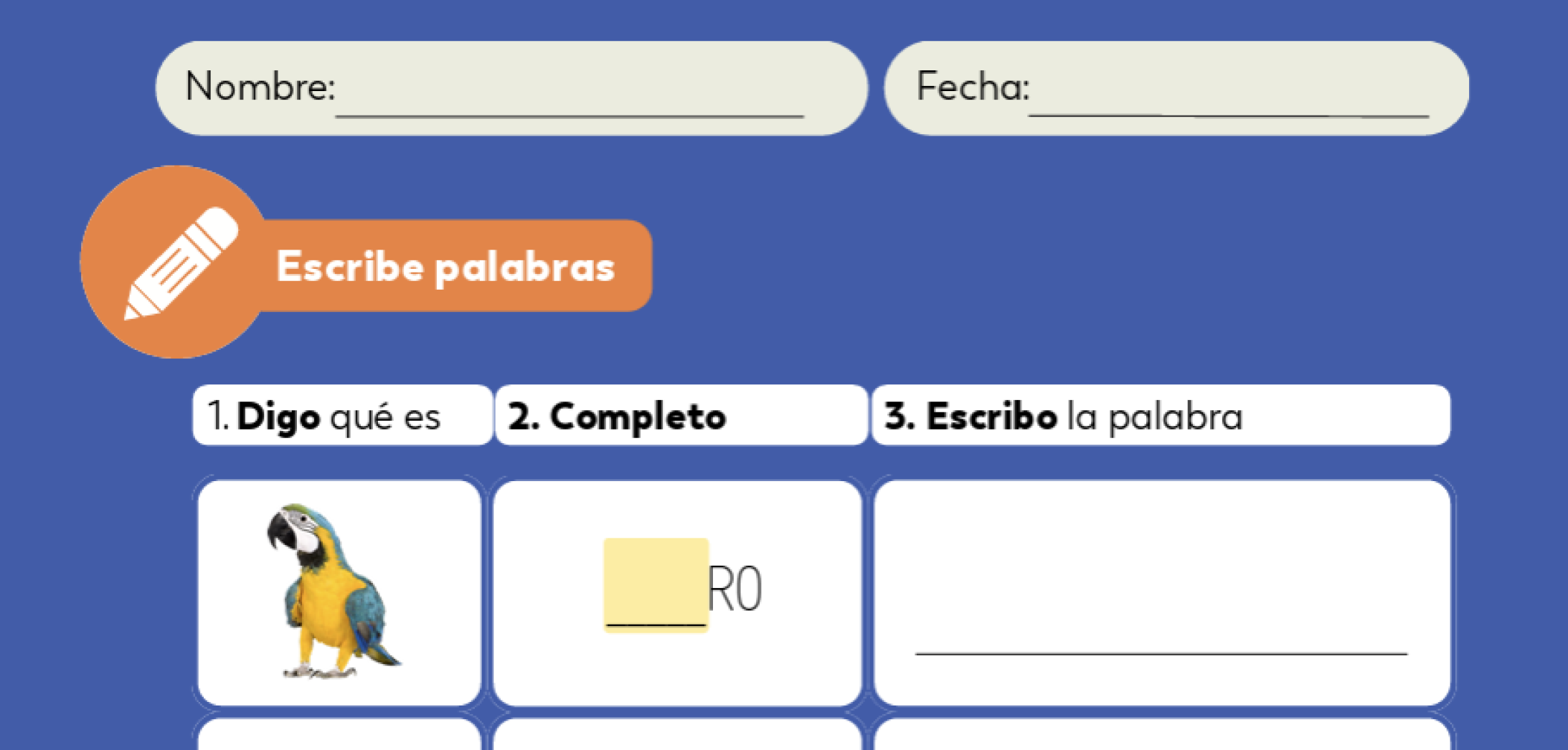
tekman’s accessible knowledge workbook
Want to see real examples of how we apply these criteria in our math and language arts programs? Download a free sample of our adapted materials!
References
- Booth, Tony, Ainscow, Mel. (2002). Índice de Inclusión. Desarrollando el aprendizaje y la participación en las escuelas (Spanish edition of Index for Inclusion: Developing Learning and Participation in Schools). UNESCO.
- Echeita, Gerardo. (2013). Inclusión y exclusión educativa. De nuevo “voz y quebranto” (Educational inclusion and exclusion: “voice and heartbreak” once again). Revista Iberoamericana sobre Calidad, Eficacia y Cambio en Educación, 11(2), 99–118.
- García, O. (2012). Lectura fácil: métodos de redacción y evaluación (Easy Read: writing and evaluation methods). Real Patronato sobre Discapacidad. Available at: https://www.plenainclusion.org/sites/default/files/lectura-facil-metodos.pdf