
Game-based learning: playful, cooperative math in secondary school
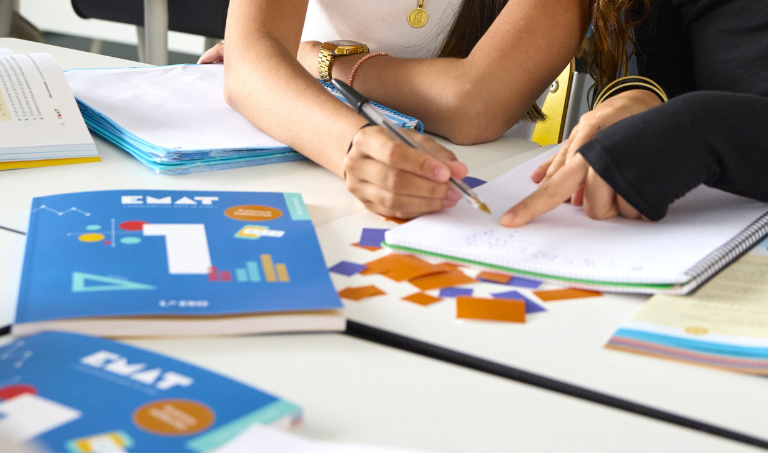
Have you noticed how the energy in your math classroom changes when you close the textbook and set a challenge? In secondary school, we often cling to the myth that games are for little kids. However, educational neuroscience tells us the opposite: the teenage brain needs emotion, social interaction, and meaningful challenges to consolidate complex knowledge.
In this post, we’ll explore how to take the stigma out of mistakes, promote inclusion, and turn your class into a space where math finally clicks.
- Games beyond points: a mathematical purpose
- Social-emotional inclusion: taking the stigma out of mistakes
- Cooperative learning and mathematical dialogue
- Consolidating knowledge vs. mechanical repetition
- EMAT Secondary in action: a real example for your classroom
- Wrapping up the game: formative assessment and metacognition
- Discover EMAT Secondary
- Frequently asked questions
Games beyond points: a mathematical purpose
When we talk about gamification in secondary school, we often think of point systems, virtual avatars, or external rewards to get students to do the same old mechanical exercises.
In EMAT Secondary, we turn this idea on its head. Games aren’t an artificial add-on for extrinsic motivation, but a teaching tool built into the learning itself. Playing in math class lets teenagers tackle abstraction in a natural, dynamic and, above all, safe way.
Games with a mathematical purpose are one of the most effective strategies for supporting diverse learners in the classroom, because they act directly on three key areas: social-emotional inclusion, cooperation, and the consolidation of knowledge.
Social-emotional inclusion: taking the stigma out of mistakes
Math anxiety is one of the biggest barriers in secondary school. Many students arrive afraid of getting things wrong, which leads them to freeze on a test or avoid participating in class for fear of being judged by their classmates.
Games turn the classroom into a safe space: When a student makes a mistake solving for x on a worksheet, they feel frustrated. But when they make a mistake calculating a root in a board game with their classmates, the error becomes part of the game. They laugh, get corrected by their peers, and try again on their next turn. Games take the stigma out of mistakes, encourage perseverance, and help build a positive math identity.
Cooperative learning and mathematical dialogue
Math doesn’t have to be a solitary experience. EMAT Secondary games are designed to be played in pairs or small groups.
When they play, students need to communicate, justify their moves, and argue for their decisions. Without realizing it, they start using math vocabulary naturally. Games also encourage peer support: a student who has understood the concept explains it to a teammate so the team can move forward, reinforcing their own learning in the process.
Consolidating knowledge vs. mechanical repetition
Practice is necessary to master algebraic or arithmetic operations. Traditionally, this was done through endless lists of repetitive exercises that led to boredom and disengagement.
Through games, we achieve the same goal (consolidating knowledge and building math fluency) while keeping attention and engagement extremely high. Students solve dozens of operations because they have an immediate game goal: moving forward on a board, cracking a code…
EMAT Secondary in action: a real example for your classroom
Here’s a practical guide to learn more about game-based learning and, in addition, a free activity from EMAT Secondary, Radical Trivia, so you can put it into action in your class today.

Wrapping up the game: formative assessment and metacognition
In EMAT Secondary, the game doesn’t end when someone wins. Real consolidation happens during the reflection that follows.
All the program’s game-based activities end with a To finish section that encourages metacognition. The teacher leads a short discussion in which students reflect on:
- Which math strategies worked best for winning?
- Which types of operations did we get wrong most often, and why?
- How did we organize ourselves as a team?
This wrap-up turns a simple game into a powerful formative assessment tool, allowing the teacher to identify which concepts need reinforcement without having to give a numerical grade.
Discover EMAT Secondary
Success in math isn’t a matter of innate talent, but of offering the right learning opportunities.
Embracing games, cooperative work, and learning based on understanding shouldn’t mean extra work in your daily planning. EMAT Secondary is a comprehensive program designed to help you manage a diverse classroom, combining thinking routines and strategies, PISA activities, visual scaffolding, and classroom-ready games.

Frequently asked questions
Are games effective for teenagers in secondary school?
Absolutely. Although there’s a myth that games are only for Early Childhood or Primary, educational neuroscience shows that the teenage brain is especially receptive to stimuli involving social interaction, challenges, and emotions. Games in secondary school aren’t a distraction, but a way to channel that energy toward complex abstract concepts, changing how students see math—from a dry subject to a rewarding, shared experience.
How do games help manage math anxiety in the classroom?
Games act as a safe space where mistakes lose their stigma. A mistake can feel like a personal or academic failure; but in a game, it’s simply something that happens and invites you to try again on your next turn. This lowers the cortisol levels linked to freezing up over math and fosters a more resilient, positive math identity.
How can you assess learning when students are playing?
Assessment in a game-based setting should, above all, be formative. The teacher observes how students interact, what strategies they use to solve problems, and how they justify their decisions. It’s also essential to wrap up with a metacognition phase (as we do at tekman Education with the “To finish” section), in which the group reflects on which math concepts were key to moving forward in the game and where they found the most difficulty.