The 7 best educational documentaries
Below, we recommend 7 educational documentaries for kids to watch on Netflix this summer, designed to enrich learning in the classroom or at home. This list, aimed at early childhood and/or primary teachers and families, offers recommendations sorted by age and topic to work on values, critical thinking, and competencies in areas such as science, nature, and history. Don’t miss them!
Chasing Coral
Why are coral reefs disappearing? How can we prevent an unprecedented ecological disaster? Chasing Coral, winner of the Audience Award for best documentary at the 2017 Sundance Film Festival, is a beautiful documentary that raises awareness of how important coral is, and its stunning cinematography will leave you in awe.
Elephant
Disney is behind this technically flawless blockbuster in which we follow an elephant named Shani and her son Jomo on their journey across the Kalahari Desert in Botswana. A movie to enjoy the animal world and highlight the importance of caring for it and respecting it at all times.
He Named Me Malala
Malala Yousafzai, the youngest person ever to win the Nobel Peace Prize, is the subject of this documentary, which explains how she became one of the most recognized social rights activists in the world. After surviving an assassination attempt and going on to campaign for girls’ education, Malala has become a key figure of our time, as this documentary shows.
Our Planet
An outstanding documentary that invites viewers to immerse themselves in the natural beauty of planet Earth and reflect on the impact of global warming on its inhabitants.
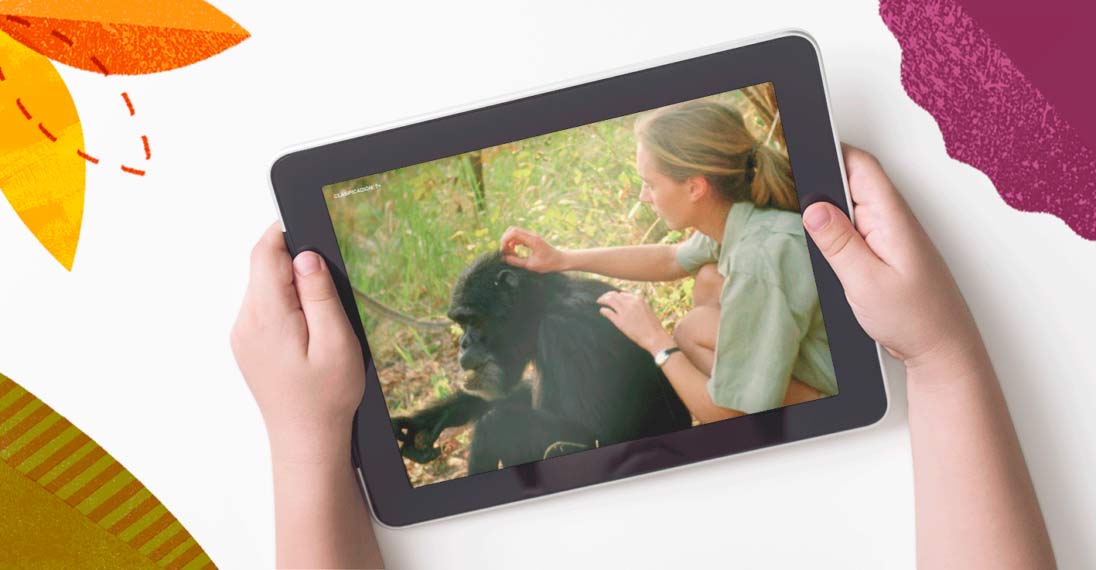
Jane
This documentary features never-before-seen footage of scientist Jane Goodall’s research on primates. Her anthropological work has made her a leading voice on the protection of chimpanzees, and this documentary is proof of that.
My Octopus Teacher
A filmmaker forges an unusual friendship with an octopus living in a kelp forest in South Africa, learning as the animal shares the mysteries of its world.
Hubble
This fascinating film, narrated by Leonardo DiCaprio and shot in IMAX 3D, tells the story of the Hubble Space Telescope and how NASA carried out its 2009 servicing mission. Get ready to enjoy planet Earth from a unique point of view!
Why do we recommend these educational documentaries? Audiovisual learning in childhood
Audiovisual learning is a teaching methodology that uses video, image, and sound resources to support knowledge acquisition, develop critical thinking, and stimulate students’ visual memory. In the early years, integrating audiovisual language makes it possible to tackle complex concepts in a contextualized, hands-on way (as in methodologies such as PBL – project-based learning).
How to use educational documentaries in the classroom, step by step
To make sure showing a documentary leads to meaningful learning and not just passive entertainment, we recommend following this 3-step structure:
- Before viewing (activating prior knowledge): Use thinking routines beforehand (e.g., “What I know, what I want to know”) and pose 2 or 3 guiding questions before you start the screening.
- Active viewing: Show short clips (10 to 15 minutes) and pause the video for brief moments of reflection or cooperative learning activities.
- After viewing (consolidation and final product): Link what students have watched to cross-curricular projects (such as tekman’s Inspira program) or set up a debate or a creative team project.
Did you enjoy the documentaries for kids we recommended? Had you seen them all? If there’s one you’d like to talk about, feel free to leave a comment below. We’re huge fans of documentaries and series, so we’re sure we’ll love your recommendation!
Looking for fun summer activities? Check out our Polo de Limón workbook collection:

From what age is it a good idea to use documentaries in class?
Age-appropriate documentaries can be used from age 3 (early childhood education), with a preference for short formats (5 to 10 minutes), rich visual content, and simple narratives focused on observing the natural and social world.
What are the benefits of using documentaries for learning at school?
Using documentaries builds sustained attention, expands vocabulary, encourages empathy toward different cultures and species, and helps students retain abstract content by putting it in a visual context.
How do you choose a suitable educational documentary for primary students?
To choose a good documentary for primary students, consider whether the language is age-appropriate, how long it is (or whether it can be split into clips), how scientifically accurate the content is, and how well it aligns with the curriculum goals of the LOMLOE (Spain’s current education law).