
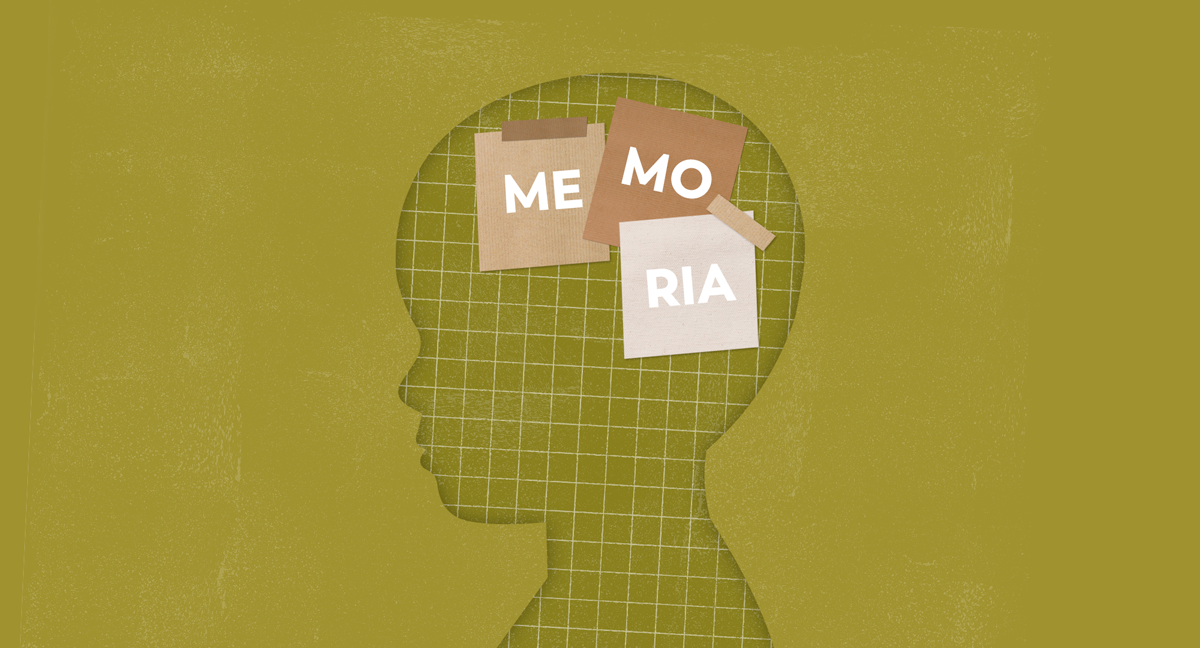
What does memorizing really mean? We may think it’s simply storing images in our minds, almost as if we were taking a photograph of the information. However, memory is much more than retaining data; it’s a way of learning. We look at what memorizing involves and why it’s so important for learning math.
Deconstructing memory and its role in learning
One of the debates in education sparked by competency-based teaching is the criticism of memory. The argument goes like this: learning something by heart means retaining it for a certain time (usually until the day of the test) and forgetting it afterward. However, we need to take a closer look at this cognitive skill by reviewing the scientific evidence from cognitive psychology. Its conclusion is clear: without memory, there is no learning.
What role does memory play in learning, and how should we interpret it? Sylvie Pérez Lima and Jordi Perales Pons, experts in educational psychology and professors at the Open University of Catalonia (UOC), address this in their article Los distintos tipos de memoria y su papel en el aprendizaje (The different types of memory and their role in learning):
“Teaching students to use and work their memory means activating prior knowledge through questions and by presenting real or familiar contexts […] and making sure they really have that knowledge. Without this first step, the student’s reaction is simply to memorize, without meaning. Without connection.”
Sylvie Pérez Lima and Jordi Perales Pons
Knowing that the real job of memory isn’t to memorize, but to make connections and create meaning, we can say that without memory, there is no learning.
Three types of memory
Generally speaking, psychology divides memory into three main categories, which interact with each other to serve different functions in learning:
1. Short-term memory (or sensory memory) is the ability to hold a small amount of information in mind, accessible for a short period of time.
2. Long-term memory can be defined as the lasting, permanent store of the information we keep.
3. Working memory connects short-term and long-term memory, using information from both to handle complex cognitive tasks.
Working memory: its powers and limitations
According to the Baddeley and Hitch model, working memory is like a temporary, limited store of information used to process complex cognitive tasks such as learning, reasoning, and comprehension.
One of the biggest obstacles in learning is not so much the content itself, but how the brain stores, accesses, and presents information. This is where working memory plays a key role, because it lets us actively process the information we’ve retained, working with it to understand it, apply it, or store it.
Efrat Furst, an expert in educational neuroscience, describes some specific features of working memory in her article Learning in the brain:
- It connects prior knowledge with new information.
- Its capacity is limited, since we can only handle 4 to 9 items.
- Overload is counterproductive and causes information to be lost.
- It is necessary for building long-term memory.
We know that working memory is key to learning and that we need to keep it in mind when designing activities for the math classroom, but how do we do that? Let’s look at some key points and practical tips.
How to plan lessons with memory in mind
Working memory is very important in teaching math! Take solving arithmetic problems: it requires understanding numbers and basic operations, as well as logical reasoning to apply the operations and reach the solution. All of this happens thanks to working memory.
The more math fluency students have, the better. As Jesús C. Guillén explains in Memoria de trabajo en el aula (Working memory in the classroom), “the fact that working memory has a limited capacity suggests that, in practice, acquiring certain automatic skills can be useful.” And that’s not all! Research shows that when knowledge is built with meaning, it’s remembered better than when it’s only analyzed superficially. So understanding knowledge and how it’s used also matter, which is why it’s essential to connect learning and revisit it repeatedly.
“No knowledge base is built in a single encounter with information. Rather, a key element of our learning system is that it is shaped over time by what we do with knowledge each time we retrieve it from long-term memory and manipulate it in working memory.”
Efrat Furst
4 keys to designing math activities
- Design meaningful experiences. The teaching context should be relevant to the student, both in how it’s contextualized and in how it’s understood. Let’s build learning so students understand what something is, why it’s that way, and where it makes sense to apply it.
- Connect learning. Connections give learning meaning and allow faster retrieval. Spending many weeks on a single area of math, such as number sense, isn’t the most effective approach. We recommend interleaving other areas, such as geometry and measurement, which offer contexts for retrieving and expanding prior knowledge.
- Plan repeated practice. If a concept is important, it makes sense to practice it often. In line with the principles of math education, skills need to be practiced by adding complexity (in reasoning, in the size of the numbers in calculations, etc.) and gradually removing supports (hands-on materials, guidelines, etc.) to develop math fluency.
- Reduce the cognitive load on working memory. If students struggle to follow activities and get lost easily, it’s time to step in. In that case, we need to watch the amount of work, clarify the steps, simplify instructions, or repeat important information often.
In ONMAT and EMAT, our math programs, we sequence content using a spiral approach to encourage repeated practice and connected learning. Revisiting content at different times and from different angles also helps support diverse learners, since it gives students more learning opportunities.
Want to learn more about the spiral approach and how to use it in math class?
Get the free EMAT spiral approach guide, with activities for your classes:
