
Competency-based assessment in math: keys to making it real in secondary school
Assessment in secondary school is often a challenge: we navigate between the bureaucracy of grades and the goal of meaningful learning. We often feel that written tests fall short of capturing our students’ potential; that’s why committing to competency-based assessment in math is key so that students stop seeing the process as a verdict and start seeing it as a guide for improvement.
At tekman Education, we believe assessment should be a living process that gathers valuable information to adjust your teaching and strengthen your students’ competency-based learning.
What is competency-based assessment in math?
Competency-based assessment is a systematic process of gathering information to analyze student performance in complex learning situations. Instead of measuring only how well students remember formulas, it looks at how they use mathematical thinking to solve challenges, connect knowledge, and make informed decisions to improve their own learning.
Planning: the teacher’s road map
For assessment to be effective without overwhelming us, it needs to be planned. It’s not about collecting data all the time, but about deciding strategically when we’ll pause to capture each student’s real progress.
- Ongoing assessment throughout the unit: build in small assessment milestones instead of a single final exam.
- Encouraging autonomy: include self-assessment during the process or before and after each unit so students can see their own progress.
- Time management: set aside specific times at the end of each unit or group of units to analyze the evidence gathered, see how your students are progressing, and decide the next step in their learning.
Strategies for gathering meaningful evidence
In programs like EMAT Secondary, the richness of assessment lies in the variety of sources. It’s essential to diversify where the information comes from:
- Active observation: essential during hands-on or game-based activities and collaborative challenges, where creative thinking and problem-solving strategies come to light.
- Analysis of digital results: tools that provide instant scores on leveled exercises, helping to detect urgent needs.
- Real-world problems: use PISA-style activities to assess the development of key skills or specific competencies in situations close to students’ lives.
- Summary tests: tools such as the “Put yourself to the test” section, which show students’ level of knowledge and skills at the end of a learning unit.
“Assessment isn’t just about recording a static numerical grade, but about obtaining useful information to guide each student’s progress and offer them the best educational response.”

Analyzing rubrics as a guide for improvement
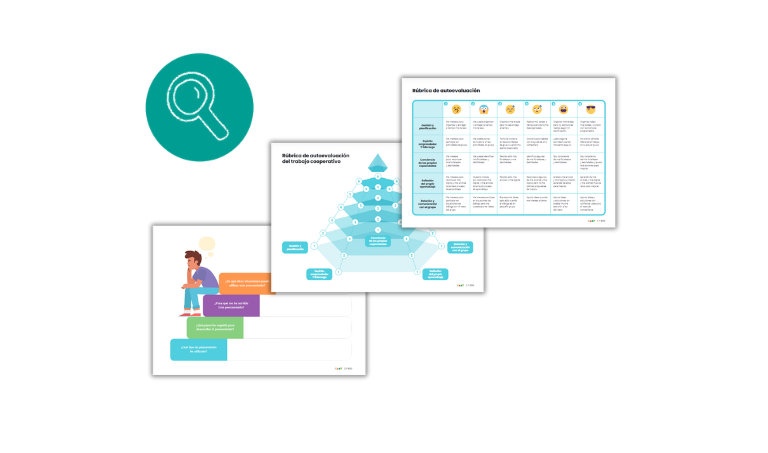
Using assessment rubrics directly linked to the specific math competencies makes it possible to grade students’ level of performance objectively and transparently. It’s essential to understand that assessment criteria and their consolidation are designed progressively throughout secondary school.
The analysis shouldn’t focus only on whether students “pass,” but on identifying their level of achievement (or how much support they need) for each criterion. If we find we’re missing information on a specific criterion, the classroom plan allows us to pivot and schedule new sessions to gather that missing evidence.
Effective communication: feedback for success
Communicating results shouldn’t be a one-off event at the end of the term, but an ongoing dialogue. Constant, regular feedback for both students and families helps align expectations and reinforce the goals achieved. By systematizing these strategies, the assessment process becomes more agile and focused on what really matters: the student’s overall development.
Want to learn more about competency-based assessment?
Don’t miss Mariana Morales’s webinar: Assessing to learn (in Spanish)
Frequently asked questions
Do I need to assess and record every student’s performance in every session?
It’s neither necessary nor practical. The idea is to observe the group as a whole to spot patterns and then focus on specific students or criteria we need more information about.
What are the keys to assessment under the LOMLOE (Spain’s education law)?
Current regulations focus on competency-based learning and formative assessment. By using graded rubrics, you not only meet the formative, ongoing approach the law calls for, but also ensure that each student’s progress toward math competency is documented.
What tools can I use to record my observations?
You can use anything from your digital planner or classroom notebook to integrated tools such as the classroom planning spreadsheet, which lets you record evidence by session or by student.
Does competency-based assessment mean I should stop giving written tests?
Quite the opposite: written tests are still necessary tools for confirming students’ mastery of basic knowledge and technical fluency. The big difference is that, in competency-based assessment, the test is no longer the only “final judgment.” Tests coexist with other tools. It’s not about eliminating exams, but about diversifying the evidence. That way, the final grade is a much fairer and more accurate reflection of what students can do, rather than depending only on how they perform on paper on a particular day.